By
|
Getting your Trinity Audio player ready...
|
In February 2026, the Union Budget sanctioned a new 2,100-km Dedicated Freight Corridor connecting Dankuni to Surat. It placed Bengal at the centre of India’s freight strategy. This single announcement changed the evaluation of every logistics park along the Kolkata industrial corridor.
Rail alignment, highway access, and port proximity no longer sit in separate categories. Together, they form one connected system that decides the transport cost, delivery speed, and long-term operational resilience.
If you are scouting warehousing or industrial space along Kolkata Industrial Corridor, location is not a line item on a checklist. It is the decision that shapes everything else that follows – from lease value to daily fuel expense.
The guide breaks down what genuinely drives value along Bengal’s industrial belt. We have backed the document with verified data, real infrastructure timelines, and practical evaluation criteria you can apply immediately.
What Is Bengal’s Industrial Corridor, and Why Does It Matter Now?
The term refers to Kolkata’s position within India’s Amritsar-Kolkata Industrial Corridor, or AKIC. It’s one of the country’s seven national industrial corridor programmes.
The AKIC follows the alignment of the Eastern Dedicated Freight Corridor. It’s planned as an industrial development band, 150 to 200 km wide, running parallel to the freight rail line.
How does this corridor connect Bengal to national industry?
According to the Government of India’s Press Information Bureau, the corridor spans roughly 1,839 km and covers seven states, from Punjab through Uttar Pradesh, Bihar, and Jharkhand into West Bengal. It links Kolkata directly to northern manufacturing clusters through one continuous freight and industrial alignment.
For businesses, this means raw materials and finished goods travel along a single planned corridor instead of fragmented regional routes. That shift reduces dependency on congested state highways for long-distance freight movement.
It explains why the belt around Kolkata remains a prime eastern industrial zone for institutional and private investment.
How Does Highway Connectivity Decide a Location’s Value?
Road access remains the backbone of last-mile and regional freight movement, even as rail infrastructure expands rapidly. A site’s real worth depends on how quickly trucks can reach ports, highways, and consumption centres.
Which highways matter most for logistics parks near Kolkata?
Three routes define eastern India’s road freight network. NH 16, formerly NH 6, links Kolkata to Chennai via Odisha and Andhra Pradesh. NH 19 connects Kolkata to Delhi along the historic Grand Trunk Road. The Kona Expressway joins Howrah directly to the Kolkata Port complex and the NH 16 corridor.
Moreover, the planned six-lane elevated flyover will connect Nibra (a major junction where NH 16 meets the Kona Expressway), to Vidyasagar Setu. It will create a faster route into Kolkata, improving cargo movement and reducing transit delays.
| Route | Connects | Relevance to Logistics |
| Kona Expressway | Howrah – Kolkata Port – NH 16 | Direct port and highway access |
| NH 16 | Kolkata – Chennai (via Odisha, Andhra Pradesh) | Southern freight corridor |
| NH 19 | Kolkata – Delhi (via Grand Trunk Road) | Northern industrial belt access |
| Eastern DFC | Ludhiana – Dankuni | Rail freight backbone |
A logistics park in Kolkata built near this junction of routes cuts transit time to both southern and northern markets. Fewer intermediate transfers also mean fewer chances for delay, damage, or added handling cost in transit.
What Role Does Rail Infrastructure Play in Freight Efficiency?
Rail has quietly become the more decisive factor for bulk and long-distance freight. It occurs particularly as the national freight corridor network matures around eastern India.
How does the Dankuni-Surat freight corridor change the map?
The Union Budget 2026-27 approved a new corridor connecting Dankuni to Surat. It spans roughly 2,100 km to link the Eastern and Western Dedicated Freight Corridors into one continuous freight spine, reports Logistics Insider. Once operational, this line will let double-stacked container trains move goods between Bengal and Gujarat without switching networks midway.
For any industrial logistics park, Kolkata developers should plan around Dankuni or the wider Howrah belt. The rail linkage adds durable strategic value beyond present-day convenience. Freight that once needed multiple handoffs across separate rail networks can move on a single track, start to finish.
Why Does Port Proximity Still Drive Logistics Costs?
Even with rail expansion underway, sea freight remains the most economical way to move bulk cargo over long distances. Proximity to a functioning, high-volume port changes the entire cost equation for warehousing operators.
What does Kolkata Port’s cargo growth signal for warehousing demand?
Syama Prasad Mookerjee Port, Kolkata, handled a record 66.4 million metric tonnes of cargo in FY 2023-24. It’s the highest volume since operations began in 1870, according to IBEF. Such volume needs storage, staging, and distribution capacity close by, not miles away in congested city zones.
A commercial warehouse in Kolkata occupiers choose near this port corridor can effectively cut drayage costs and turnaround time meaningfully. It can also reduce dependency on Chennai or Visakhapatnam ports for eastern and North Eastern trade, including Nepal-bound cargo.
How Is Supply Chain Demand Reshaping Industrial Real Estate in Kolkata?
Occupier behaviour tells you where the market is actually headed, beyond what infrastructure announcements alone can promise.
Which sectors are driving warehousing demand in Kolkata right now?
Warehousing in Kolkata recorded 6.5 million square feet of leasing activity in 2024. As per Knight Frank India data reported by India Shipping News, it’s 28% year-on-year from 5.1 million sqft in 2023. Third-party logistics operators and e-commerce companies led this demand, with the latter capturing 29% of national transactions.
The growth pattern favours locations with proven supply chain infrastructure and occupiers’ trust in Kolkata over untested peripheral land parcels. Manufacturing is steadily increasing its share of transactions too. It’s adding a second demand driver beyond e-commerce and 3PL activity alone.
What Should You Check Before Choosing a Logistics Park Location?
Before committing to any site, run it against a short but non-negotiable checklist. Skipping any one of these points usually shows up later as an unplanned operating cost.
| Site Parameter | Core Evaluation Criteria | Primary Operational Benefit |
| Highway Access | Travel time to NH 16, NH 19, or expressway junctions. | Cuts fleet turnaround times. |
| Port Proximity | Drayage time to Kolkata or Haldia Dock Complex. | Lowers import-export container costs. |
| Rail Linkage | Proximity to Dankuni or freight terminals. | Enables efficient multimodal transport. |
| Utility Reliability | Uninterrupted power for cold storage and automation. | Prevents costly inventory spoilage. |
| Building Specs | Floor load capacity, clear height, and fire compliance. | Maximises vertical storage efficiency. |
| Legal Clarity | Clear land titles and proper regulatory registration. | Eliminates long-term compliance risks. |
| Labor Supply | Skilled and general workforce availability from nearby areas, such as Santragachi and Mourigram. | Ensures smooth, round-the-clock shifts. |
Each factor compounds over time rather than standing alone. A site with strong highway access but weak rail linkage still adds hidden cost across a multi-year lease term.
Where Does PS Logistics Park Fit Into This Growth Story?
Location decisions along this corridor increasingly point toward the Kona Expressway, near Santragachi. The preference is driven by its direct, seamless link to the Kolkata Port, NH 16, and the extensive Howrah rail network. PS Logistics Park sits within this stretch, near the same port-highway junction described earlier in this piece.
Its relevance comes mainly from geography – proximity to the freight and highway infrastructure that Kolkata’s warehousing occupiers prioritise. Smart businesses choosing a top supply chain facility in Kolkata industrial warehouse in Kolkata favour established strategic corridors. Such optimal placement removes all operational guesswork regarding future logistics site selection.
How PS Logistics Park Sets the Benchmark on Kona Expressway?
For businesses evaluating the Kona Expressway corridor, PS Logistics Park serves as a prime industrial real estate option. Spanning massive areas, this advanced hub completely eliminates daily operational friction through highly meticulous planning protocols.
Here are the core standout features that make this project the best investment in industrial spaces for sale near Kolkata:
- Strategic Proximity: The facility sits 6 kilometres from Vidyasagar Setu, ensuring seamless cargo movement along vital transit routes.
- Grade-A Infrastructure: The modern layout features wide internal driveways, heavy dock levellers, and generous clear ceiling heights for warehousing.
- Workforce Welfare: The estate provides professional on-site dormitories, medical rooms, cafeterias, and a dedicated employee child care crèche.
- Uncompromising Safety: Advanced protocols integrate 3-tier surveillance, automated number plate recognition gates, and high-grade fire-fighting tools perfectly.
- ESG-Compliant Design: The green development includes solar power panels, zero wastewater discharge systems, and beautiful open landscaped spaces.
How does this specific facility redefine industrial storage?
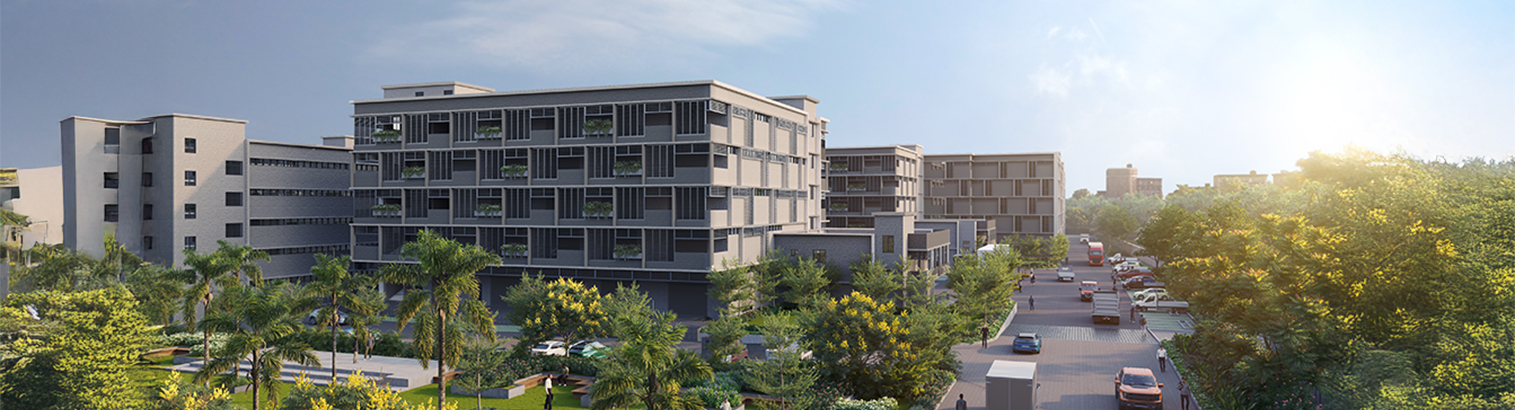
Located right on the Kona Expressway, this project represents modern warehousing perfection. It is the premier industrial logistics park in Kolkata, with meticulous design to optimise operations. The project spans over 1.8 million square feet with 147 independent units.
You get massive 15-metre-wide driveways, ensuring that large freight trucks move without friction. This low-density layout minimises internal congestion and accelerates your cargo handling processes. Such precise architectural design sets a brand new standard for premium industrial spaces.
What makes it the ultimate choice for your business?
The logistics park provides state-of-the-art dock levellers and spacious freight-handling cargo lifts. These features cater to manufacturing units and third-party supply chain operators. The human-focused environment emphasises safety, well-being, and the seamless integration of processes.
It serves as an ecosystem where businesses scale fast, and teams thrive. Finding a logistics park along the Kolkata industrial corridor elevates your commercial capability. You gain a massive competitive advantage through superior infrastructure and unmatched geographic location.
Your Logistics Advantage Starts With the Right Address
The logistics park along the Kolkata industrial corridor you choose will shape your operating costs for the next decade. Highway access, rail linkage, and port proximity together decide whether your supply chain runs efficiently or fights friction daily.
Bengal’s infrastructure story is accelerating, from the AKIC’s national alignment to the newly sanctioned Dankuni-Surat freight corridor.
Evaluate any logistics hub Kolkata offers against verified data, not projected timelines alone. The right location does the quiet work of keeping your business competitive for years, long after the lease is signed.
Frequently Asked Questions
1. What makes a location ideal for warehousing near Kolkata’s industrial belt?
Ideal locations combine direct highway access through NH 16 or NH 19, proximity to Kolkata Port, and rail linkage near Dankuni. These factors reduce transport time, lower operating costs, and support long-term supply chain performance.
An ideal warehouse location near Kolkata’s industrial belt should be closer to city’s commercial hubs, with Burrabazar and Alipore reachable in approximately 32 minutes. Combined with strong highway connectivity and efficient transport links, this proximity supports faster deliveries, smoother operations, and lower logistics costs.
2. How far is Kolkata Port from major industrial zones near Howrah?
The Kona Expressway connects Howrah’s industrial belt directly to Kolkata Port and NH 16 within a short drive. Such proximity reduces drayage costs and turnaround time for cargo moving between warehouses and dock facilities daily.
3. Why is the Eastern Dedicated Freight Corridor important for Kolkata’s logistics sector?
The Eastern DFC terminates at Dankuni, linking Kolkata to northern industrial states through dedicated rail freight. Moreover, the newly sanctioned Dankuni-Surat corridor extends this network further. It links eastern and western India through one continuous freight line.
4. Does location affect long-term operating costs for a warehouse or logistics facility?
Location directly affects fuel costs, delivery speed, and labour access over a facility’s lifetime. Poor connectivity compounds yearly expenses. Proximity to highways, ports, and rail corridors keeps costs predictably lower across long lease terms.
Leave a comment